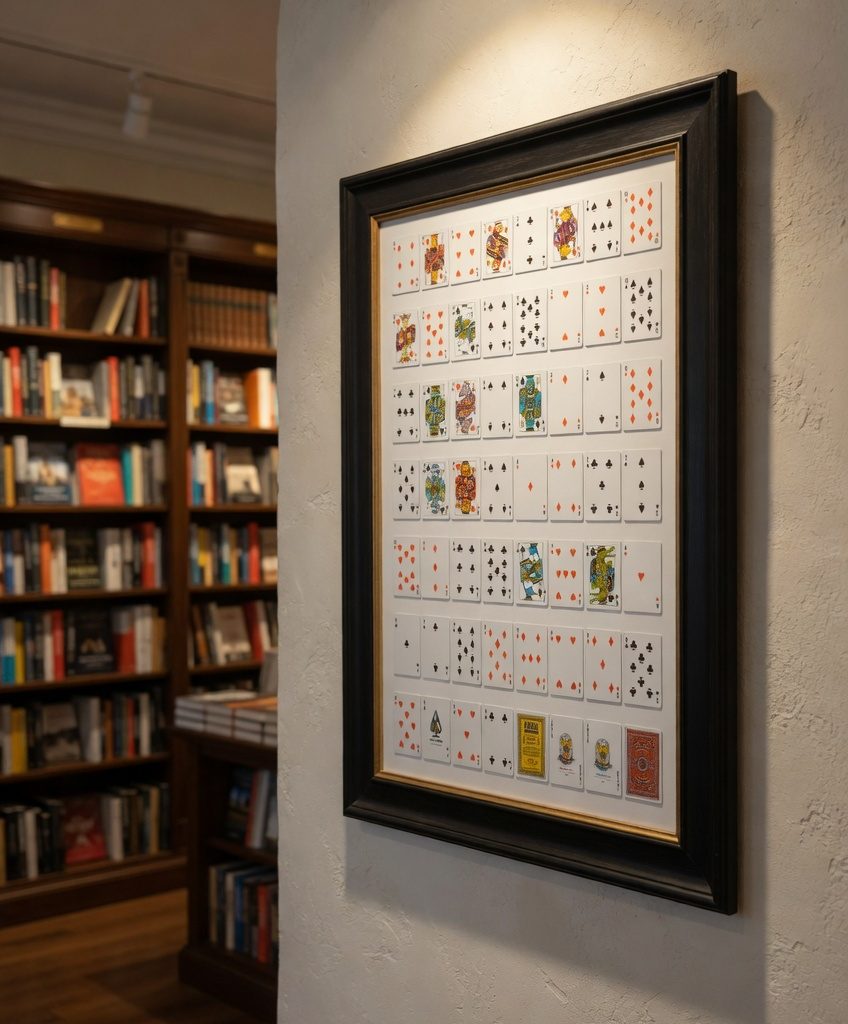
People ask this one a lot once they realise every board is marked 1/1. The short version is that prints would undo the reason I make the work in the first place.
Each piece starts with a real shuffle of a real deck. I record it, then I hand-assemble every card onto the A1 board in the exact order they fell. A standard deck has so many possible arrangements that the same sequence basically never happens twice. That number is huge — bigger than most people can picture — and the whole point of the boards is that I’ve frozen one of those moments. If I then made prints, the certificate that lists the exact order would stop meaning anything. The object would just become a picture of itself.
I thought about editions early on. Most artists do them, and it makes practical sense if you want more people to be able to own something related to the work. But once I started actually assembling the cards I couldn’t see how an edition would fit. The value sits in the fact that this particular order only exists on this particular board. Galleries that have looked at the pieces usually get that faster than private buyers do. They are used to thinking about what can sit in a collection without needing a number after the title.
The boards themselves are straightforward to handle — same size, same method, framed and ready. No questions about which print is which or whether the surface matches the original. When someone visits the studio in West London they can see the real cards under the plexi, the slight differences in thickness between decks, the small irregularities that come from hand assembly. A print can’t carry that.
So I keep it simple. One shuffle, one board, one certificate. Thats the piece. If someone wants something that exists in more than one copy, there are plenty of other artists doing that well. This just isn’t that.